Children learn in different ways. Some enjoy drawing and coloring, while others prefer solving puzzles, exploring numbers, recognizing words, or completing creative challenges. But AI is changing learning activities for children. For parents, teachers, and educational content creators, providing activities that support different learning styles can be both rewarding and time-consuming.
How Teachers and Parents Can Save Time in the Era of AI:
Creating meaningful educational materials requires more than putting a few questions on a page. Activities need to be appropriate for a child’s age, easy to understand, visually engaging, and structured in a way that encourages gradual development. Teachers often need to prepare additional resources outside classroom hours, while parents may spend considerable time searching for suitable activities to support learning at home.
At the same time, the growth of artificial intelligence is changing how educational resources are developed. Tasks that once required hours of manual writing, designing, formatting, and organizing can now be supported by specialized digital tools.
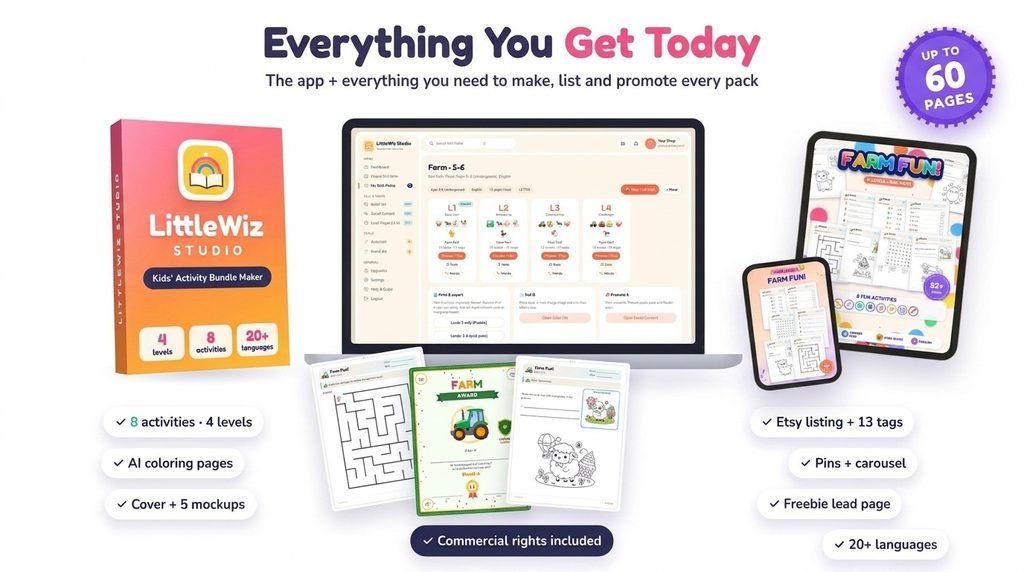
One example is LittleWiz Studio, a browser-based application designed to generate children’s activity bundles using selected topics, age groups, and languages. Its approach brings together different educational activities, answer keys, printable layouts, and supporting materials in one workflow.
But the more interesting question is not simply how quickly an application can create worksheets. It is how structured activity creation can add value to children’s learning, help educators organize their resources, and give digital content creators a more manageable production process.
Why Educational Activities Matter?
Children develop important skills through regular practice, exploration, and interaction with their surroundings. AI is rapidly transforming learning activities for children. Traditional classroom instruction provides essential knowledge, but children also benefit from opportunities to apply what they learn through practical activities.
For example, a simple coloring exercise can encourage creativity and attention to detail. A maze can introduce problem-solving and visual planning. Word searches can support letter recognition and vocabulary practice, while basic mathematics worksheets provide opportunities to strengthen number recognition and calculation skills.
These activities may appear simple, but they encourage children to participate actively rather than simply receive information. In the era of ai Learning Activities for Children changing fast.
Consider a child learning about animals. Reading a list of animal names is one way to introduce the topic.
However, combining that lesson with
picture matching, word tracing, coloring, and counting activities creates several opportunities to interact with the same subject.
This approach can make learning more varied and enjoyable.
The important consideration is that activities should match the child’s developmental stage. A worksheet designed for a preschooler should not have the same complexity as one intended for an eleven-year-old student.
This is where organized educational resources become particularly useful.

hear how in the ai era Children Learning Activities Changing fast.
Preparing educational materials involves several individual tasks.
A teacher creating a classroom activity pack might need to:
- Choose an appropriate educational topic.
- Identify learning objectives.
- Prepare age-appropriate questions.
- Design worksheets and illustrations.
- Create puzzles and practical exercises.
- Prepare answer keys.
- Organize the pages into a logical sequence.
- Format the materials for printing.
Each task requires attention and time.
Parents who homeschool their children may face similar challenges. They need to find activities that match their child’s interests while maintaining an appropriate level of difficulty.
Digital educators and printable creators have additional responsibilities. Beyond creating the educational content, they may need to design covers, prepare product images, write descriptions, and organize files for online distribution.
When every step is completed manually, even a relatively small activity bundle can become a lengthy project.
Digital tools can help reduce some of this workload by bringing several production tasks into one organized process.
3. What Is LittleWiz Studio help?
LittleWiz Studio is a web-based application designed to create children’s educational activity bundles from selected topics.
Instead of designing every worksheet individually, users can enter a subject, select an age group, choose a language, and select the types of activities they want to include.
The application generates a structured collection of educational materials organized into four difficulty levels.
Its intended audience includes printable content creators, teachers, homeschoolers, and people who develop educational resources for children.
The platform supports children between approximately three and twelve years old and offers multilingual content generation.
Its main purpose is to simplify the process of developing printable educational materials by combining activity creation, page organization, and supporting design tasks.
According to its website, the application can generate up to 60 pages this is how in the ai era Children’s Learning Activities Changing fast. in a complete bundle, that depending on the selected activities and configuration.
This creates an opportunity to organize several learning exercises around one subject instead of preparing unrelated worksheets separately.
4. How AI Changing Children Learning Activities in a Different way?
One of the most useful aspects of structured educational materials is the ability to combine different activity formats.
LittleWiz Studio includes several activity types that can be used for different learning purposes.

Coloring Activities
Coloring gives children an opportunity to explore shapes, recognize objects, and express creativity.
For example, a space-themed activity pack might include illustrations of rockets, planets, astronauts, and stars.
Children can identify the objects, choose colors, and connect visual information with words they are learning.
Coloring can also provide opportunities to practice controlled hand movements, although individual developmental outcomes vary.
Mazes and Puzzles
Mazes introduce children to simple problem-solving tasks.
They need to identify a starting point, understand the available paths, and find a route toward the destination.
This type of activity encourages children to observe details and consider different possibilities before making decisions.
AI is Changing Learning Activities for Children and helps to Word Searches and Word Tracing:
Word searches introduce children to written vocabulary through visual recognition.
A topic such as farm animals might include words like cow, sheep, horse, and chicken.
Word tracing provides another opportunity to practice letter formation and become familiar with spelling.
Together, these exercises can make vocabulary practice more interactive.
Mathematics and Counting
Basic mathematics activities help children practice numbers, counting, and simple calculations.
For younger children, picture-based counting exercises can connect numerical concepts with familiar objects.
For older children, more challenging calculations can provide opportunities to strengthen their existing knowledge.
Picture Matching and Fill-in-the-Blank Exercises
Matching activities encourage children to recognize relationships between pictures, words, and concepts.
Fill-in-the-blank exercises give them opportunities to recall information and complete incomplete sentences or patterns.
The combination of these activities creates variety within a single educational topic.
5. Why Different Difficulty Levels Are Important
Children do not all learn at the same speed.
Even when two children are the same age, their reading abilities, vocabulary, problem-solving skills, and familiarity with a particular subject may differ.
Giving every child exactly the same level of difficulty may not always produce the best learning experience.
LittleWiz Studio addresses this organizational challenge through its four-level Skill Path structure.
The activities progress from Level 1 to Level 4, with increasing difficulty.
For example, a topic about animals could be organized as follows:
- Level 1: Recognizing animal pictures, basic coloring, and simple word tracing.
- Level 2: Matching animals with their names and completing easier word searches.
- Level 3: Solving more challenging puzzles and completing vocabulary exercises.
- Level 4: Working with larger word-search grids, longer mazes, and more advanced activities.
This structure gives educators and parents a convenient way to organize activities around increasing complexity.
It can also help content creators develop a more coherent educational resource rather than collecting unrelated pages into one document.
However, the suggested age range should be treated as a starting point. Adults should still consider each child’s actual abilities and learning needs.
6. How AI is Changing Learning Activities for Children Saving Time Through Organized Content Creation
Time is an important consideration for Children’s Learning Activities anyone developing educational materials regularly.
A teacher may have several lessons to prepare in one week. A homeschool parent may need new activities for different subjects. A printable creator may want to develop multiple products without spending every evening designing individual pages.
LittleWiz Studio brings several production stages together.
Its workflow generally involves three steps:
Step 1: Select a topic.
Users can enter subjects such as space, farm animals, dinosaurs, emotions, or other educational themes. They can also choose an age group, language, and activity types.
Step 2: Generate the activity bundle.
The application creates the selected activities across four difficulty levels, including supporting answer keys.
Step 3: Prepare the final materials.
Users can export printable PDFs and work with additional features such as cover design, product mockups, listing content, and social media graphics.
The platform also supports US Letter and A4 page formats.
This type of workflow can reduce repetitive production work and allow users to spend more time reviewing educational quality, adapting materials, and understanding what children need.
Time savings should not mean skipping quality checks. Reviewing generated content remains an important responsibility.
7. Supporting Parents and Homeschool Learning
Parents often look for practical ways to make learning part of everyday family life.
A child might become interested in dinosaurs after visiting a museum, watching an educational documentary, or reading a storybook.
That interest can become the starting point for several simple activities.
For example, parents could introduce dinosaur coloring pages, matching exercises, basic counting tasks, and vocabulary worksheets around the same in the ai era Children’s Learning Activities Changing fast this way
This creates opportunities for children to explore one subject through different activities.
Parents can also participate by asking questions, discussing pictures, helping children understand unfamiliar words, and celebrating their completed work.
LittleWiz Studio can help organize these materials into printable collections, making it easier to prepare themed learning sessions at home.
It does not replace parental involvement, direct instruction, or interaction with children. Rather, it provides materials that adults can use as part of those experiences.
8. Helping Teachers Organize Classroom Resources
Teachers frequently work with students who have different levels of understanding.
A single classroom lesson may require additional exercises for students who need more practice, as well as more challenging activities for students who are ready to progress.
Organized activity bundles can help teachers prepare supplementary exercises around a shared topic.
For instance, a science lesson about the solar system could be accompanied by coloring activities, word searches, vocabulary exercises, and age-appropriate mathematics tasks.
Teachers can select relevant pages, print them, and incorporate them into classroom activities or individual practice sessions.
The ability to organize materials across four difficulty levels can also help teachers prepare differentiated activities.
However, teachers should review the generated resources before distributing them. Educational accuracy, curriculum alignment, accessibility, and suitability for individual students remain important considerations.
9. AI is Changing Learning Activities for Children by creating Opportunities through Educational Content:
Educational content creation has become an area of interest for people who enjoy developing learning resources.
Some creators publish printable worksheets, activity books, planners, and educational materials through digital marketplaces.
However, developing a complete product involves more than preparing its pages.
Creators also need to consider presentation, organization, product descriptions, and how potential users will discover their resources.
LittleWiz Studio includes several features intended to support this wider process.
These include:
- Printable activity bundle generation.
- A cover designer.
- Five product mockup images.
- Etsy listing titles, descriptions, and tags.
- Pinterest pin generation.
- A five-slide Instagram carousel.
- A lead page for sharing a Level 1 sample and collecting email addresses.
These features connect educational content development with the practical work of organizing and presenting digital resources.
The application also provides commercial-use options for eligible content created through the platform. Users should review the applicable license terms and marketplace policies before distributing or selling their materials.
It is important to remember that creating a digital product does not guarantee customers or revenue. Success depends on educational quality, originality, audience needs, pricing, competition, and consistent marketing.
10. AI is Changing Learning Activities for Children and adding value of Multilingual Educational Materials:
Language can influence how children interact with learning resources.
A child who is more comfortable reading in Spanish, French, German, Japanese, or another language may benefit from activities presented in that language.
LittleWiz Studio supports more than 20 languages, allowing users to generate materials for different language audiences.
For example, a creator developing a basic vocabulary pack could prepare versions for English-speaking and Spanish-speaking learners.
This can be useful for multilingual households, language-learning environments, and creators serving different communities.
Nevertheless, automated language generation requires careful review.
Translations, spelling, grammar, cultural references, and age-appropriate vocabulary should be checked before materials are used with children.
Language support is most valuable when it improves accessibility without sacrificing accuracy.
- Checking spelling and grammar.
- Reviewing the difficulty of each activity.
- Testing puzzles and checking answer keys.
- Examining illustrations and page layouts.
- Printing sample pages to check readability.
- Confirming that the content is suitable for the intended age group.
Technology can make production easier, but educational responsibility remains with the person using the materials.
12. The Bigger Picture: Making Learning Resources More Accessible
The development of AI-assisted educational tools reflects a broader change in how learning resources are created.
Previously, producing a complete activity book could require separate design software, illustration resources, puzzle creation, formatting, and manual organization.
Specialized applications can now bring several of these processes together.
For parents, this may mean having more options for preparing themed activities at home.
teachers, it can provide another way to organize supplementary classroom exercises.
For educational creators, it can reduce repetitive design work and make it easier to develop structured collections.
The real value is not simply the number of pages produced or the speed of generation.
It is the ability to turn an educational idea into organized, adaptable materials that can be reviewed and used in meaningful learning situations.
When adults combine these resources with discussion, guidance, encouragement, and age-appropriate challenges, digital tools can become a useful part of the wider learning environment.